


308 Views Aug 24 linda-admin
Let’s be honest: you’ve probably scrolled through your fair share of dramatic before-and-after photos and wondered, “Could that be me?”
It’s a fair question, especially now that robotic hair transplant technology has made precision placement more consistent than ever. But the truth is that even the most advanced robotic system can’t create hair out of thin air. You only have so much donor hair to work with, and every graft it extracts still has to survive being moved before it can grow anywhere new.
So how much can a robotic hair transplant actually restore? That depends less on how sophisticated the machine is and more on what’s already going on with your scalp. Two people can sit down in the same robotic-assisted chair and walk out with completely different plans. Why? Because the “right” amount of restoration looks different for everyone.
Let’s break down what robotic technology can realistically deliver, and where it hits its limits.
Solution 1: Robotic FUE Hair Transplants (High Precision for Moderate Coverage)
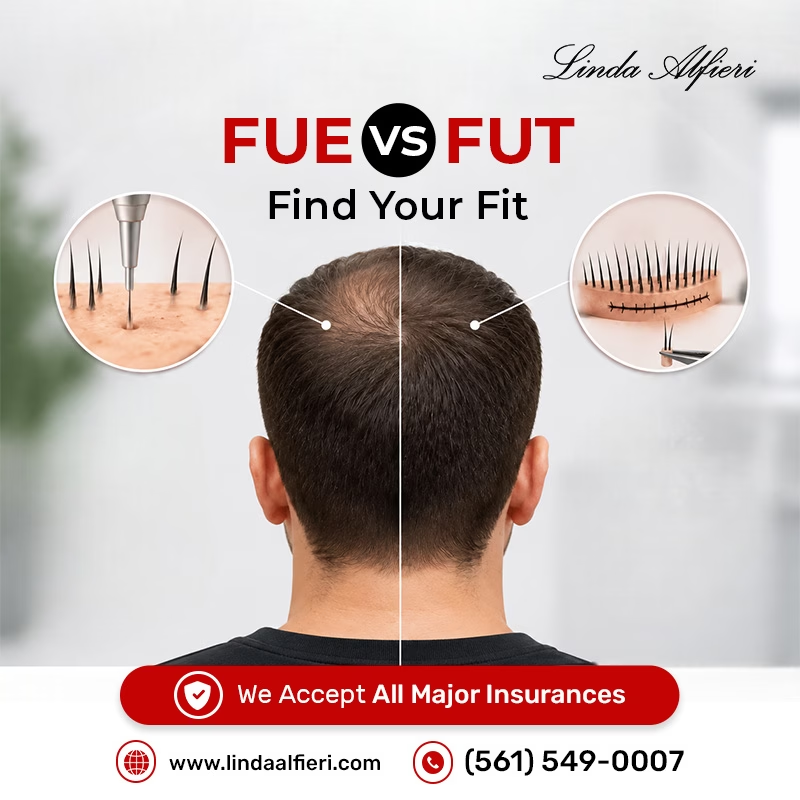
Robotic FUE, or Follicular Unit Extraction, uses a robotic arm guided by imaging software to identify, extract, and prepare individual follicular units with a level of consistency that’s hard for even the steadiest human hand to match.The system scans your scalp, and maps hair angles and density in real time. Then it selects the healthiest follicles for harvesting, reducing transection rates and human fatigue error over a long session.
What Can You Actually Expect with ROBOTIC FUE?
Most robotic sessions land somewhere between 1,500 and 3,500+ grafts, depending on how much donor hair you’ve got and how the robotic mapping reads your scalp’s density. Survival rates usually run 90 to 95 percent when the extraction and placement are handled correctly. You won’t see much for the first few months. But by month four things start filling in, with the full picture showing by 12 to 18 months.
People love robotic FUE for the near-invisible scarring, the algorithm-assisted natural hairline design, and skipping a long incision to heal. The catch? The robot is still capped by what your donor area can give up, not by how much coverage you’d ideally want.
Extensive balding often means one robotic session won’t cut it. And the technology fee tends to push costs higher than older manual or strip methods.
Discover the 5 things no one tells you about FUE hair transplants.
Solution 2: Hybrid Approach (Robotic Hair Transplant + Regenerative Hair Loss Therapies)
Here’s something a lot of people don’t think about: even a robotic hair transplant only handles the bald spots it’s mapped and harvested for. It doesn’t do anything for the hair around it that’s already thinning. That’s where a hybrid approach earns its keep, pairing robotic-assisted grafts with regenerative therapies like PRP or stem cell-based treatments.
Think of it as a two-front strategy. The robotically placed grafts fill in permanent coverage where hair is gone for good. On the other hand, PRP or regenerative injections work on the surrounding hair that’s still hanging on, boosting blood flow and follicle health so it doesn’t disappear next.
For early-to-moderate hair loss, this combination is often one of the most effective thinning hair treatments out there. It’s tackling two problems at once instead of relying on the robotic system alone.
Solution 3: Custom Non-Surgical Hair Systems & Additions (For Advanced Balding / Depleted Donor Zones)
What if there simply isn’t enough donor hair left for even the most precise robotic system to work with? Maybe your donor zone has been over-harvested from a previous procedure, or you’re further along the Norwood scale than robotic extraction can address. That’s not a dead end. It just means a custom non-surgical hair system might be your better fit.
These aren’t the hairpieces you’re picturing. They’re custom-matched to your natural growth pattern and scalp color. You can wear them full-time or blend them right in with existing robotically transplanted hair. No surgery, no recovery time, no waiting months to see if grafts took.
The obvious win is speed: full coverage, immediately, regardless of what your donor area can or can’t supply. You get zero downtime and full choice over density, texture, and color. The tradeoff is that it’s not a permanent biological fix. So you’re looking at periodic maintenance and eventual replacement, plus a short adjustment period getting used to wearing and caring for it day to day.
Discover what cyber hair is and why women are choosing it.
Restore Your Hairline with the Right Strategy
At the end of the day, it comes down to two things: how much donor hair you actually have, and where you land on the Norwood or Ludwig scale. Catching things early? A standalone robotic hair transplant might be all you need. Further along? A hybrid plan or a non-surgical system layered alongside robotic surgical work will likely serve you better.
So, how much can a robotic hair transplant really restore? A provider you can trust will tell you what’s realistic before a single graft is ever placed, not after. That’s exactly the approach at Linda Alfieri Hair Replacement Center & Full Service Medical Centre.
Curious what’s actually realistic for your scalp? Schedule a personalized consultation with Linda Alfieri Hair Replacement Center and start building a plan around your hair, not someone else’s results.